
We're a concrete building at Río Volga 105, in Cuauhtémoc, steps from Paseo de la Reforma. If you came looking for a brutalist hotel in Mexico City, this is what you get: raw material left honest, rooms organised around a courtyard, and a program that runs from the morning pool to the late records. Built in concrete, tuned by sound. That's the short version.
Design Milk wrote about us in November 2024 under the headline "Visit Mexico City's Boldly Experimental Architectural Heritage at Hotel Volga". We didn't pick that line, but we'd stand behind it.
What makes the building brutalist
The concrete stays visible, and the building is arranged around a void rather than a lobby. You walk in and the structure is the first thing you read. Nobody has plastered over it or dressed it up in marble to apologise for it. The materials do the work: concrete, volcanic rock, water, and the light that falls between them.
We use the word brutalist the way most people searching for it do. It means a building that shows you what it's made of. Ours does that from the courtyard up to the roof.
The Urban Cenote
The Urban Cenote is the courtyard at our center, where light and water meet the concrete. A cenote is a natural sinkhole, open to the sky, and the idea here is the same: a vertical opening cut through a solid mass. It's the room you'll pass through most, and it's the one most people photograph first.
Four rooms worth knowing
Each of the shared spaces is a study in one material or one idea. Here's how they break down.
| Space | What it is | What to look at |
|---|---|---|
| Urban Cenote | Our central courtyard | Light and water against concrete |
| Mezcalería | Agave spirits from small producers, poured slowly | The volcanic rock wall behind the bar |
| Minos Hi Fi | Our soundroom, built for serious listening | Two round columns and a bottle wall that runs the full height of the room |
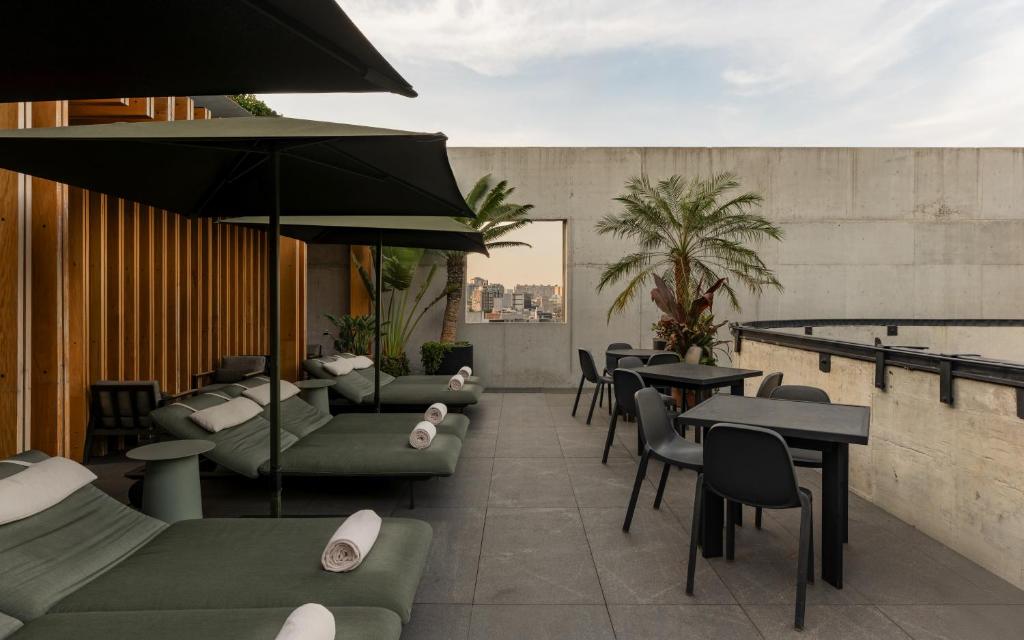
| Rooftop | Loungers, palms, the Day Club and a swimming channel | A concrete parapet with an aperture cut through to the skyline |
Mezcalería: low ceiling, a wall of volcanic rock behind the bar, and light that comes mostly off the bottles. It seats fewer people than you'd expect, on couches rather than a row of stools. Come here for the stone, stay for the agave.
Minos Hi Fi: two round columns frame the bar and the shelves climb all the way up. The light off those bottles is most of the light in the room. A resident sound program plays through the evening, and it runs late.
The rooftop: the brightest room in the building, and the only one without a ceiling. The parapet is solid concrete with an opening cut through it, so the city gets framed rather than sprawled. The Day Club runs up here when the weather holds, with a swimming channel and DJ sets.
Elora: our restaurant on the ground floor. It works with local Mexican produce and precise technique, nothing overworked. Breakfast starts at 07:00 and the kitchen closes at 22:30, every day. Reserve ahead, even as a guest.
The rooms
We have five room types, from 22 to 85 square meters: Deluxe Queen, Deluxe King, Deluxe Double Bedroom, Junior Suite and Grand Suite. The Deluxe Double Bedroom sleeps four on two double beds, with its own bathroom and shower in 27 square meters. The rest sleep two. If the architecture is the reason you're booking, go for the Grand Suite. It gives you the most of the building to live in.
The concrete around us
You don't have to leave Cuauhtémoc's grid to keep looking at serious modern building. Two anchors are close.
The Angel of Independence is the column on Reforma that everyone uses to give directions, and we're near it. Use it as your landmark when you walk out to Reforma. Reforma itself is the city's long ceremonial avenue, lined with towers from every decade since the 1960s, and it's the easiest architecture walk you can take from our door.
Museo Nacional de Antropología, in Chapultepec Park, is the building to see if you came for mid-century concrete. Pedro Ramírez Vázquez designed it with Jorge Campuzano and Rafael Mijares, and it opened in 1964. The courtyard is covered by El Paraguas, a single huge canopy held up on one column, with water falling from it. Give the collection a half day at least. Go early, and walk straight to the courtyard before the galleries, so you see the canopy before the crowds stand under it.
Getting here
We're at Río Volga 105, between Reforma and Zona Rosa, about 2.4 miles from the historic center. The metro at Insurgentes is ten minutes on foot. Our front desk is staffed around the clock, and check-in is from 15:00.
Who this building is for
People who'd rather sleep inside something with a point of view. If you want carpet, swagged curtains and a chandelier in the lobby, we're the wrong address. If you want to spend the afternoon on a concrete roof, eat at Elora, and finish in Minos Hi Fi listening to someone who cares which record follows which, book a room.